You can't print your way out of a metal problem… Or a scandium one
Published 15-AUG-2026 13:26 P.M.
|
20 minute read
Disclosure: S3 Consortium Pty Ltd and its associated entities may hold direct or indirect interests in securities referred to in this publication and may receive fees or other forms of consideration from entities mentioned. These interests and arrangements may create a potential conflict of interest in the preparation of this material.
The information contained in this communication is provided for general information purposes only and may relate to speculative investments. It does not constitute financial product advice, and has been prepared without taking into account your personal objectives, financial situation or needs. You should consider obtaining independent financial advice before making any investment decision.
Any forward-looking statements are uncertain and not a guaranteed outcome.
Exactly 55 years ago today...
US president Richard Nixon went on national TV to announce he was "temporarily" suspending the US dollar's convertibility into gold.
(yep, each US dollar used to be convertible into gold from the US government...)
This happened after France had been rapidly redeeming its US dollar holdings back to gold and then Britain asked to do the same...
Nixon quickly put a handbrake on all that.
That "temporary" suspension has now lasted 55 years.
~95 years ago (almost today) in 1931, the global super power of the time Britain, announced that the Pound Sterling (the global reserve currency at the time) would no longer be backed by gold...
(World Wars aren't cheap, and you can’t print gold backed currency)
Keep reading to find out how the British Empire’s actions all the way back in 1914 set off a chain of events over the last 100 years that has led to small ASX stocks going up for the last two weeks.
And finally, 15 days ago today, the small end of the stock market started going up.
Another week of green this week, another step closer to me being right on my prediction of a run starting in July.
It was US critical minerals stocks that shone this week.
Last weekend (Aus time) US President Donald Trump hosted 200+ mining bosses at a White House roundtable and announced over US$2BN in funding for critical minerals assets.
"The Department of War is investing $400 million to expand production of Scandium, one of the world's most valuable aerospace and defence materials, in Australia."
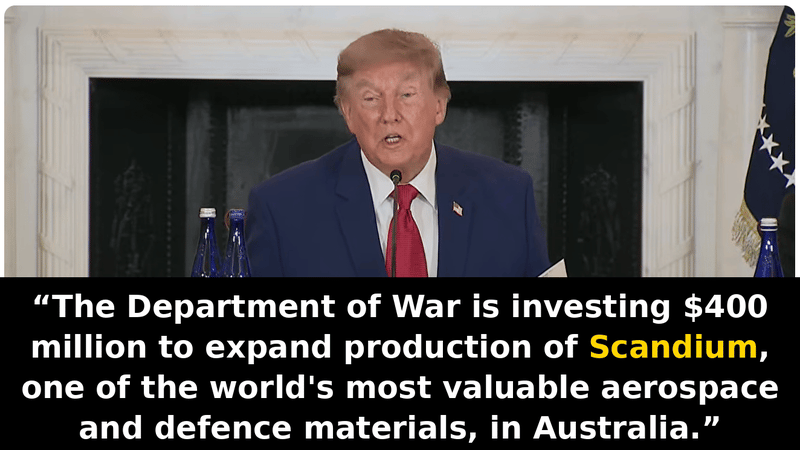
(listen to it here)
The project receiving that US$400M sits in NSW, Australia... next door to and on the same geological structure as our latest Investment - Australian Mines (ASX:AUZ)....
Why is the US Dept of War putting up US$400m to build a scandium mine all the way over in Australia, ASAP?
We’ll explain why in a second, but it starts with pre-1914 world power Britain eventually handing over world dominance to the USA.
And a unique, strategic move by the USA that shaped the next 70 years of how we buy everything we need.
(no country in history had tried it before)
But First - Here is a quick dot point summary of why we Invested in AUZ - see our full initiation note here.
Why we Invested in AUZ:
- AUZ owns one of the highest grade scandium resources in the Western world - 446ppm, versus Sunrise at 408ppm and Rio Tinto's nearby deposit at 405ppm...
- Neighbour Sunrise has a Lockheed Martin offtake option, a US$400M loan commitment from the US Department of War, and is now planning a US listing.
- The valuation gap is ~40x - Sunrise is capped at ~$3BN, AUZ at our Initial Entry Price was capped at $58M (now it’s capped at $82M)
- AUZ has a similar mine plan to neighbour Sunrise - both projects sit on the same geological structure AND have the same planned ~60tpa output (AUZ's asset is smaller in tonnage, but higher grade, with a simpler 3-pit mine plan versus Sunrise's 13).
- AUZ's 2026 scoping study showed a Net Present Value (NPV) of US$860M based on a US$3,000 per kg scandium price - The US Defense Logistics Agency is paying US$6,250 per kg for its stockpiles - at US$6,000 per kg AUZ’s NPV is US$2.04BN
- China controls the market (for now) - ~80% of global scandium mining, ~100% of processing, and export controls on every form of scandium since April 2025.
- AI data centres are the demand kicker - ~74% of global scandium demand comes from ONE company, Bloom Energy, which makes the fuel cells powering AI data centres.
More on Bloom in a second...
- Scandium is also a military metal - a small amount makes aluminium stronger and lighter, essential for fighter jets, missiles, hypersonics and 3D printed aerospace parts...
- We think AUZ's asset could end up in the US - via takeover, JV or a US listing event...
- AUZ’s run to a ~$235M market cap on another one of its assets during the 2017-18 battery metals boom - it still owns 100% of that project...
- Plus we also like its gold project in Brazil - an earn-in to 80% of a gold project with a ~336koz historic estimate and monster historic hits (104.5m @ 1.59g/t).
And here is our AUZ Big Bet:
"AUZ re-rates to a $500M+ market cap by advancing its scandium project toward a development decision and/or becomes the subject of a corporate transaction (takeover, JV, or US-listing event) at multiples of our Initial Entry Price."
NOTE: our “Big Bet” is what we HOPE the ultimate success scenario looks like for this particular Investment over the long term (3+ years). There is no guarantee that our Big Bet will ever come true. There is a lot of work to be done, many risks involved, including development risk and commodity price risk - just some of which we list in our AUZ Investment Memo.
Success will require a significant amount of luck. Past performance is not an indicator of future performance.
We went down the scandium rabbit hole...
The big “elephant in the rabbit hole” for scandium is US$62BN NYSE-listed Bloom Energy.
They consume ~74% of the world's scandium - making fuel cells that power AI data centres (servicing customers like Amazon and Oracle).
(Bloom fuel cells are made with ~10% scandium oxide AND each GW of capacity needs roughly 25-60 tonnes of scandium)
The big bull case for scandium is if Bloom hits its 2030 targets and grows its capacity to 5GW in line with analyst estimates.
If that happens, Bloom’s demand alone could 5x the size of the global scandium market.
(just one company doing one thing...)
If we think Bloom’s growth is going to happen - then being Invested in a scandium project makes a lot of sense.
If you look at Bloom sceptics - owning scandium makes a lot of sense too...
Last month Bloom was the subject of a short report from a US group (Hunterbrook).
The short report is called "Bloom's Big Lie". (source)
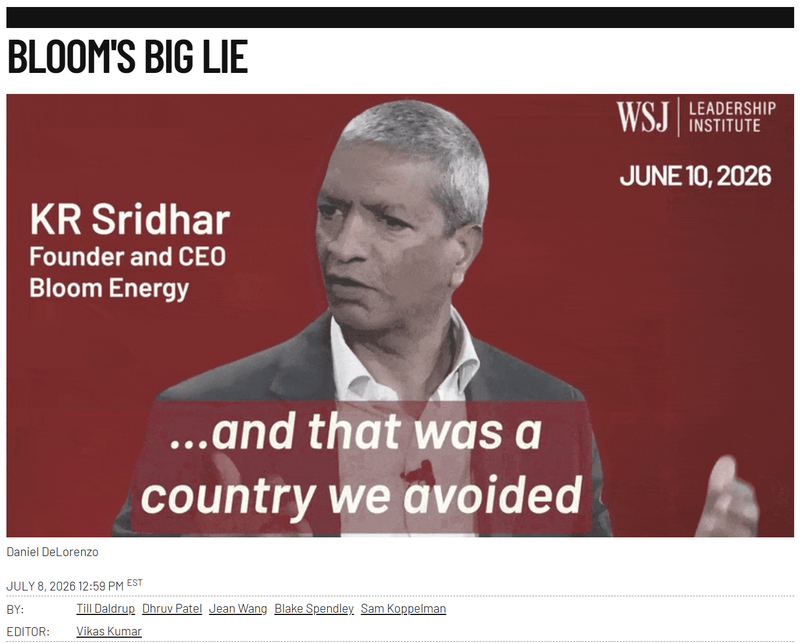
(source)
The main argument from the shorts is the claim Bloom’s scandium supply chain is heavily reliant on China...
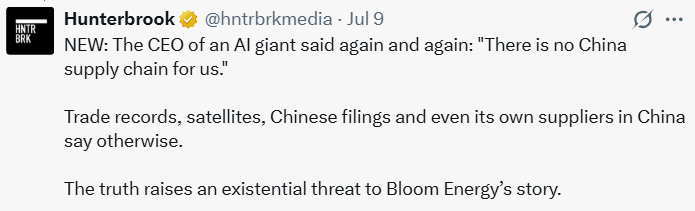
(source)
AND that at any time China can switch off supply and kill Bloom’s supply of scandium, kicking USA AI efforts right in the nuts:
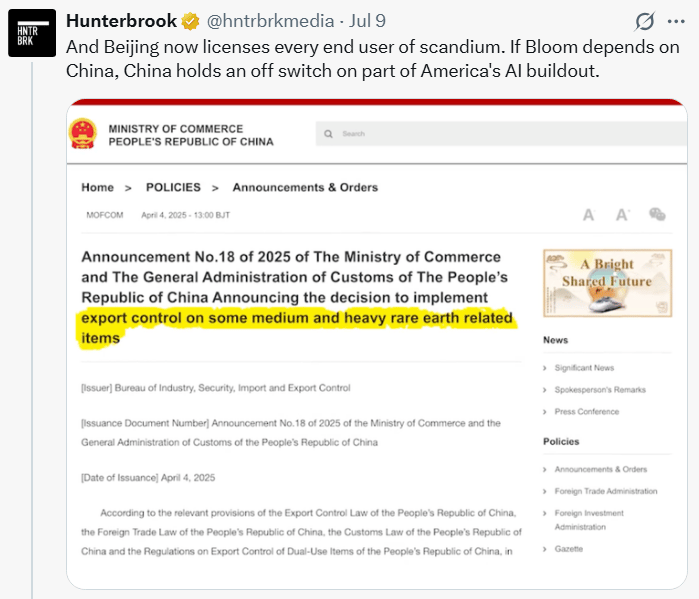
(source)
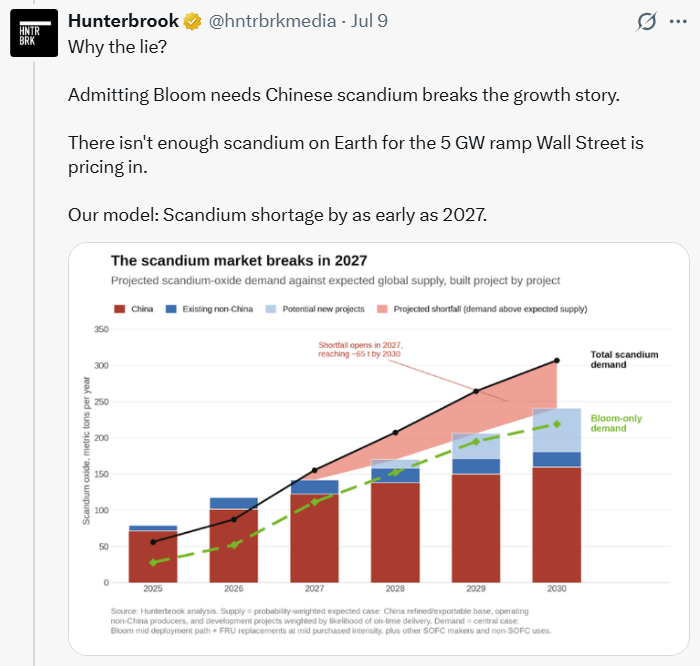
AND that there won't be enough scandium to fuel Bloom’s claimed growth forecasts:
(source)
Bloom's stock dropped ~12% off the back of that report.
Bloom’s response to all of this was that they have "sufficient scandium oxide to meet our current fuel cell demand and backlog" and that its supply is "not dependent on China".
They also say they have "clear visibility into our supply chain to support production of 25GW of fuel cells per year."
We are generally pretty optimistic but even by our standards, that is a big call.
25GW of Bloom Fuel Cells would mean ~600 tonnes to ~1,500 tonnes of scandium demand a year...
Compared to the current market of ~80 tonnes per annum.
Which means someone, somewhere, is going to have to bring on new mine supply (outside of China).
And again, this is for just one company, doing one thing with scandium.
All of this is before any military demand...
Who knows what the US Department of War and Lockheed are cooking up...
(Lockheed did a scandium offtake deal with AUZ’s neighbour for up to 25% of production for the first 5 years)
After reading that short report, it's hard to not be bullish on scandium project owners which win in either of the two scenarios:
- Bloom is right - It ramps up to 5GW+ by 2030, meaning Bloom ALONE would need ~220 tonnes of scandium a year - nearly 3x current global production.
- The shorts are right - Bloom doesn’t have the scandium supply it needs and will need to use its US$62BN market cap to find (or incentivise) a supply response.
Or, of course option 3) Bloom calls it quits and abandons its growth plans, risking cratering US$62BN in market cap.
You would think Bloom would rather just use 1% of its market cap and underwrite a mine instead of calling it quits.
We have no idea what Bloom (or the DoW/US government) will do next...
BUT we are pretty comfortable holding onto AUZ for a few years to see how this one plays out.
Especially right next door to the scandium project that the USA has handpicked to bring online...
But let's take a step back for a second.
(waaay back)
How did we even get to the US Department of War putting up US$400m to get a scandium mine built all the way over in Australia?
Let's go back to the beginning...
Pre-1914: When the British Empire was the number one world power.
(I promise I’ll come back to how this is all relevant to small ASX stocks)
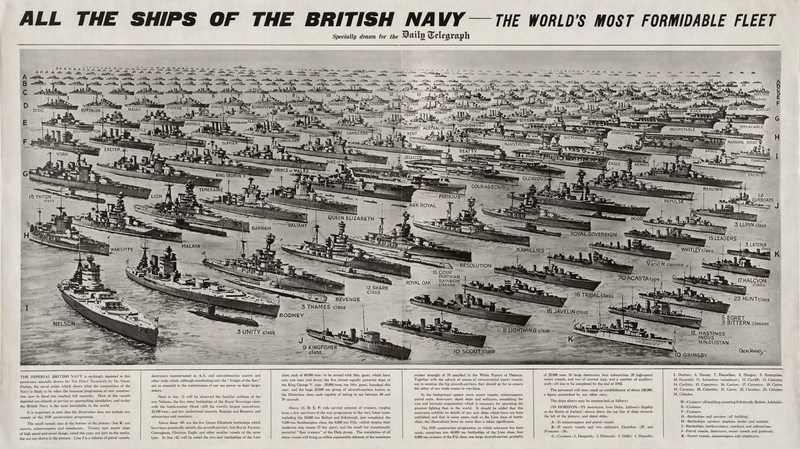
The British Empire in 1914 looked unbeatable.

The Royal Navy was bigger than the next two navies combined.
(source)
The Pound Sterling (backed by gold) financed ~60% of world trade - London was the world's banker.
BUT...
The up and coming global young buck - the USA, had overtaken Britain in manufacturing back in the 1880s.
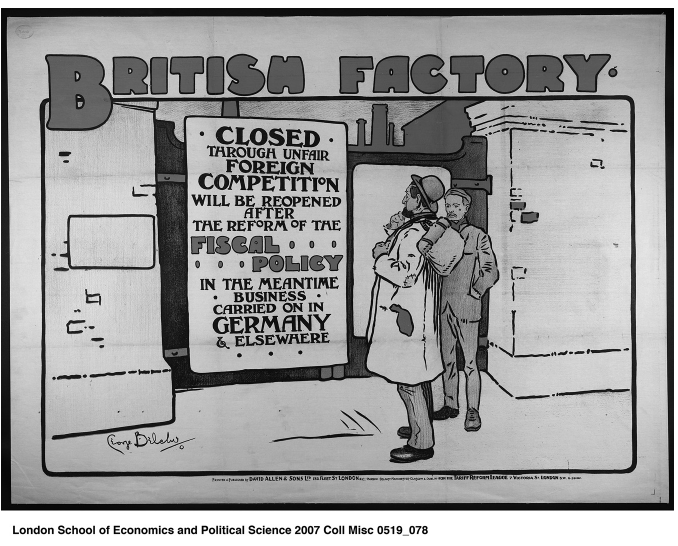
By 1913 America made ~32% of everything on Earth. Britain made ~13%.
(thanks to the post US civil war industrial revolution)
Britain was running the world on finance, prestige and a big navy - while importing the actual "stuff" from the country that would eventually replace it (as global superpower).
(any of this sounding familiar?)
After (the expensive) World War 1, Britain went from the world's biggest creditor to owing the USA billions.
(a LOT more measured in today's debased money).
British Pound Sterling convertibility into gold was suspended in 1914 to fund WW1 (Printy McPrintface).
It briefly went back to gold in 1925 but on 21 September 1931, Britain left gold for good - the sterling dropped ~25% almost immediately.
WWI exposed that Britain couldn't make dyes, optics or magnetos without Germany (its enemy), it passed the Safeguarding of Industries Act 1921.
Between the two World Wars, Britain did what waning empires do:
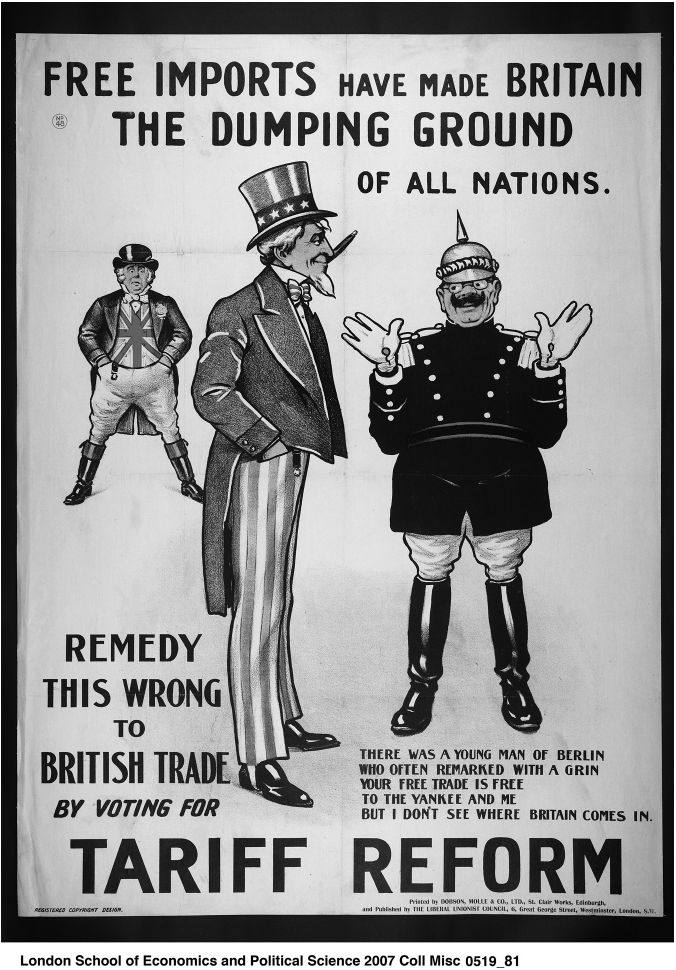
- Put up tariff walls
- Stopped being able to afford its own military
- Tried everything to revive its rusting industrial base
- Wrecked its economy defending its currency's prestige.
(the US meanwhile? Just kept manufacturing everything... and waited)
Britain's late-1930s re-industrialisation and rearmament kinda worked - shadow factories, radar, the Spitfire; Britain out-produced Germany in aircraft in 1940.
But it was expensive.
By December 1940 Britain had run out of gold and US dollars, was selling its American subsidiaries at fire-sale prices and shipping bullion to Canada to pay for US planes.
By 1945 (the end of WW2) Britain was bankrupt - debt at ~250% of GDP.
In World War 2, the USA saved Britain's butt by revving its mighty manufacturing base into overdrive - humming factories pumping out planes, tanks, ships and ammo faster than the enemy could destroy them.
(and obviously the Manhattan project)
So the US spent 1914-1941 as the "neutral" that sold to everyone, financed everyone, held two thirds of the world's gold, built the world's biggest navy and stockpiled strategic materials...
Then walked into the post WW2 rubble and wrote the new set of global rules.
That playbook sound familiar?
(cough, cough, China)
Whoever holds the metal writes the rules.
The US dollar has been the world's reserve currency ever since the end of WW2, 81 years ago.
(and 55 years ago today, Richard Nixon announced the US dollar would no longer be backed by gold...)
These days the US appears to be running 1914 Britain's playbook - a kind of waning global power mullet haircut of reserve currency, finance and a giant navy out front, manufacturing hollowed at the back.
China looks like it’s running the USA's 1914 playbook - manufacture everything (~30% of world manufacturing), build the world's biggest navy (by ship count), stay "neutral" while supplying everyone...
...and quietly buy up all the gold.
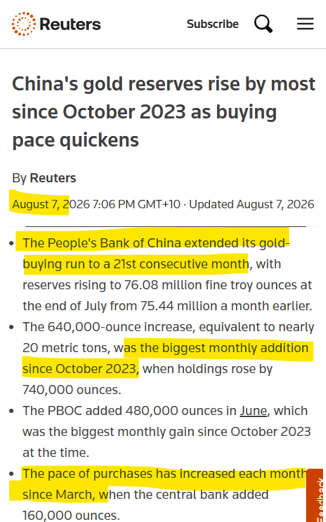
(China's central bank has bought gold for 21 straight months - remember, a massive gold holding is what gave the US dollar its global reserve currency crown in the first place)
(source)
The Britain-to-USA global power handover took two world wars and 50 years.
(and these were allies that spoke the same language...)
Nobody knows what a USA-China handover might look like - OR whether it even happens at all.
(Don’t discount the USA just yet - the British empire had two major phases of global power over 400 years, USA has had one over the last ~80 years)
And remember the old saying: history doesn't repeat itself, but it often rhymes.
AI, robots and the infinite knowledge and infinite manufacturing capability that comes with them are the modern wild card here.
(can design anything with AI, can manufacture anything with robot labour = whoever has most AI and robots wins)
We are invested in the non-infinite bottleneck here - the minerals needed to build them.
Anyway - enough of this history rhyming segue - and almost back to what all this has to do with small ASX stocks we are Invested in.
So it's now 1945, the USA has all the gold and does all the manufacturing, and was key in winning WW2.
Historically winners of major wars took all the “stuff” (land and natural resources).
Not the USA, they took a different approach - which led to “globalisation of trade”.
For most of history, seizing land and resources was the whole point of winning a war.
Rome took Spanish silver mines and Egyptian grain.
Colonial empires like Britain at its peak, or Dutch East India company at its peak were basically resource extraction machines.
Even after WW1, the victors carved up the losers' assets directly:
- France took the Saar coalfields,
- Britain and France split Middle East oil territories between them.
- and Germany was hit with reparations designed to strip its wealth for decades.
After “winning” WW2, the USA broke that pattern, and it's one of the more interesting strategic decisions of the 20th century.
(here’s the first step of how we got to where we are today - unravelling globalisation of trade that countries rely on for their critical minerals combined with the rapidly emerging geopolitically strategic race to build AI, robots and advanced weapons as fast as possible)
Instead of annexing territory or seizing resources from Germany and Japan, America did roughly... the opposite.
It spent billions rebuilding its defeated enemies (the Marshall Plan in Europe, reconstruction in Japan).
It built a system where it didn't need to own resources because it controlled the architecture through which resources moved.
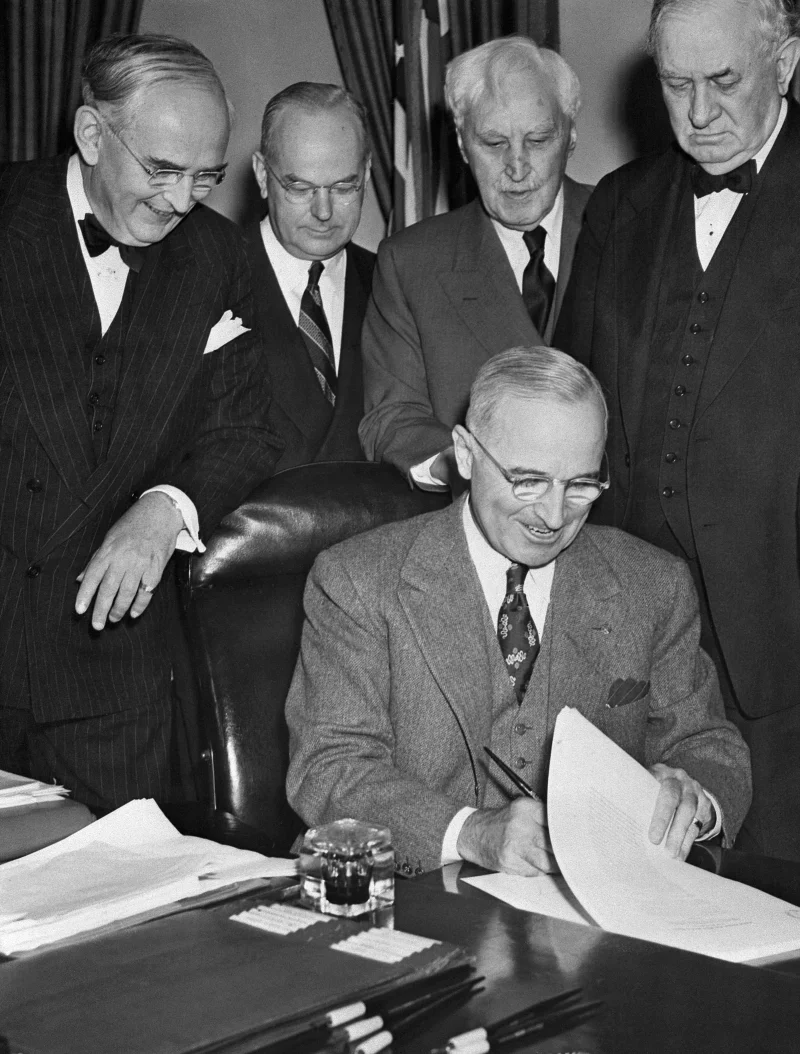
44 countries signed the Bretton Woods agreement - the deal that officially crowned the US dollar as the world's money - everyone pegged to the dollar, the dollar pegged to gold.
(the USA had two thirds of the worlds gold at the time)
The General Agreement on Tariffs and Trade (later the WTO) locked in open trade.
The US Navy guaranteed freedom of the sea lanes that all commodities travel on.
So instead of "we own the mine and mineral supply," the USA’s strategy became "everyone sells into a market that we bankroll, priced in our currency, shipped on oceans we patrol."
BUT...
Slowly, over time, the USA stopped mining and manufacturing domestically, letting other countries do it (especially China) in this new US led system of free global trade priced in US dollars.
A few reasons it worked out that way.
First, the US had learned from WW1:
- First - Economist John Maynard Keynes had predicted that crushing Germany with reparations would breed another war, and he was right.
- Second, America was resource-rich domestically, so it didn't need the loot as badly as, say, industrialising but resource-poor Japan had when it invaded China to steal its resources.
- Third, the Cold War made prosperous allies more valuable than plundered vassal states - West Germany and Japan needed to be strong to hold the line against the USSR, which notably went the traditional route, dismantling East German factories and shipping them home.
The US “empire” was informal: control the rules, the currency, and the shipping lanes, not the manufacturing or mines themselves.
The relevance to today is that this system is what's now fraying.
And it's why we have seen the USA throw down US$400M to build a scandium mine in Australia.
Amongst other urgent efforts to secure critical minerals supply domestically OR from allies.
(and this is where we see the opportunity in US critical minerals, gold and silver)
China's approach (locking up African and South American mines, processing dominance in rare earths and other critical minerals) looks much more like the “old school” war winner ownership model.
And the US response (reshoring, critical minerals deals, export controls) is effectively an admission that "the global free trade market will provide" no longer holds when your rival owns the supply chain.
And the sudden “must win at any cost” race to develop AI, robotics and advanced weapons systems (and the critical minerals supply needed to do it) has made everything urgent.
Aside from oil over the last 50 years, we haven't really seen any resource "strategic and important” enough for countries to get really hot and bothered about...until now.
We are heading into a world of infinite intelligence (AI) and infinite labour (robots).
Making it faster and easier to design and build... anything and everything.
But when designing and building is infinite - the bottleneck is access to the FINITE minerals and materials needed to build.
And when the minerals are finite and in high demand by everyone - no amount of money can buy them.
You need to own and control the mines.
You can usually print money at a problem.
You can't “print” copper, scandium, rare earths, antimony or tungsten.
However,
Personally we are more than happy to take some of that sweet, sweet printed money to buy out the mining projects we are Invested in...
That's why we are heavy in US critical minerals.
And the money printing that will likely happen to fund this must-win-at-any-cost build out race is why we are heavy in gold and silver.
Silver actually neatly straddles BOTH the AI, robotics and advanced weapons build out theme as a critical input AND the currency debasement theme as a monetary metal.
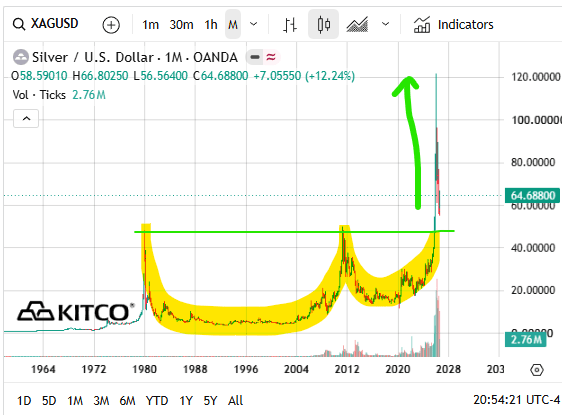
Speaking of silver - Remember that 50 year silver price “cup and handle” formation we talked about for ages?
The chart pattern that looked like a cup and handle, and when it broke out of that pattern the silver price went nuts?
(source)
The past performance is not and should not be taken as an indication of future performance. Caution should be exercised in assessing past performance. This product, like all other financial products, is subject to market forces and unpredictable events that may adversely affect future performance.
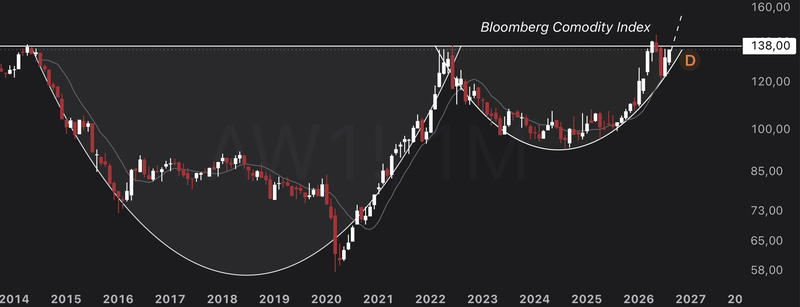
Well here’s another pre-pop cup and handle we have noticed...
In the Bloomberg Commodity Index (BCOM).
BCOM is the most widely used benchmark for commodities as an asset class. It tracks a basket of ~24 commodity futures.
(if BCOM is going up, it means the prices of commodities in general are going up)
(source - resourceAlpha on X)
The past performance is not and should not be taken as an indication of future performance. Caution should be exercised in assessing past performance. This product, like all other financial products, is subject to market forces and unpredictable events that may adversely affect future performance.
We are watching this one closely, because BCOM up = commodity bull market.
Which = small ASX resource stocks go on a run.
And we think the breaking of global trade in strategic commodities will be the driver.
Post WW2, for the first time ever, nobody had to “fight” for resources - any country could just buy them on the open global market.
COVID in 2020 was kinda like a “fire drill” for when this “I can just buy whatever I need from overseas if I have the money” system started creaking.
(Remember all the shortages of stuff during COVID when shipping ground to a halt? And countries started hoarding important stuff?)
Over the last couple of years China added more nails to the global free trade coffin with export controls on gallium and germanium (2023), graphite, antimony (price went 4-5x), rare earths (April 2025)...
(critical minerals needed to build AI, robots and advanced weapons)
Meanwhile the US is $39.83 TRILLION in debt, adding $7.9 billion a day, with interest eating 18.5% of all federal revenue - an all-time record.
It will tick over $40 trillion roughly... now.
And the very institutions that print the money are showing you what they think about all this.
Central banks have bought 1,000+ tonnes of gold a year since 2022, just posted a record second quarter, and gold has overtaken the Euro as the world's #2 reserve asset.
China has bought gold for 21 months straight.
Every western government seems to have worked out the same thing at the same time: the only thing they can't print is the physical stuff.
So in summary:
Critical minerals for the AI, Robots and Advanced Weapons build out race.
Gold for global currency debasement
Silver for both.
Here are all the stocks we hold in each theme:
Our critical minerals Investments:
- SGQ ($385M) - Rare earths and niobium in Brazil
- SS1 ($204M) - Silver (solar and electronics demand) in Nevada, USA
- RML ($98M) - Antimony and tungsten (plus gold) in Idaho, USA
- AUZ ($82M) - NEW: Scandium, nickel and cobalt in New South Wales and Queensland
- PNN ($70M) - Rare earths and niobium in Brazil, lithium in Argentina
- ION ($70M) - Critical minerals recycling tech (lithium, nickel, cobalt, rare earths) based from South Australia operating in the USA
- AW1 ($44M) - Gallium, germanium and indium in Utah, USA (plus copper in Canada)
- OD6 ($38M) - Fluorspar in Nevada, USA (plus rare earths in Western Australia)
- RCM ($36M) - Gallium in British Columbia, Canada (plus silver in New South Wales)
- HVY ($27M) - Garnet in Western Australia (naval/defence abrasives)
- LKY ($27M) - Antimony and rare earths in California, USA
- VKA ($25M) - Tungsten in Nevada, USA
- PR1 ($20M) - Advanced thermal management tech in the USA plus rare earths, graphite and garnet in Western Australia
- PUR ($20M) - Lithium in Argentina (plus gold)
- NC1 ($14M) - Nickel and cobalt in Western Australia
- LSR ($13M) - Rare earths in Arizona, USA (plus gold in Western Australia)
- PFE ($8M) - Antimony (with silver) in Arkansas, USA (plus lithium via EnergyX Investment)
Our gold Investments:
- TTM ($176M) - Gold (and copper) in Ecuador
- KAU ($130M) - Gold producer in Tasmania and Victoria
- RML ($98M) - Gold (with other critical minerals) in Idaho
- BKB ($84M) - Gold in Nevada (plus silver in Texas)
- HAR ($38M) - Gold in California, USA and in Senegal
- AVM ($31M) - Gold in Victoria (plus silver in Mexico)
- WAU ($25M) - Gold in Western Australia
- BPM ($23M) - Gold in Western Australia
- PUR ($20M) - Gold in Argentina (plus lithium)
- LSR ($13M) - Gold in Western Australia (plus heavy rare earths in USA and copper in Chile)
- TG1 ($13M) - Gold (and copper) in Western Australia
Our silver Investments:
- SS1 ($204M) - Silver in Nevada (with antimony), USA
- IVR ($126M) - Silver in South Australia
- BKB ($84M) - Silver in Texas, USA (plus gold in Nevada)
- MTH ($41M) - Silver (and gold) in Mexico
- WCE ($37M) - Silver in Western Australia
- RCM ($36M) - Silver in New South Wales (plus critical minerals in Canada)
- AVM ($31M) - Silver in Mexico (plus gold in Victoria)
- PAT ($18M) - Silver in Peru (plus copper in Zambia)
- PFE ($8M) - Silver in Arkansas, USA (plus lithium Investment in EnergyX)
Have a great weekend,
Next Investors
Did someone forward this to you? Subscribe Here
General Information Only
This material has been prepared by StocksDigital. StocksDigital is an authorised representative (CAR 000433913) of 62 Consulting Pty Limited (ABN 88 664 809 303) (AFSL 548573).
This material is general advice only and is not an offer for the purchase or sale of any financial product or service. The material is not intended to provide you with personal financial or tax advice and does not take into account your personal objectives, financial situation or needs. Although we believe that the material is correct, no warranty of accuracy, reliability or completeness is given, except for liability under statute which cannot be excluded. Please note that past performance may not be indicative of future performance and that no guarantee of performance, the return of capital or a particular rate of return is given by 62C, StocksDigital, any of their related body corporates or any other person. To the maximum extent possible, 62C, StocksDigital, their related body corporates or any other person do not accept any liability for any statement in this material.
Conflicts of Interest Notice
S3 and its associated entities may hold investments in companies featured in its articles, including through being paid in the securities of the companies we provide commentary on. We disclose the securities held in relation to a particular company that we provide commentary on. Refer to our Disclosure Policy for information on our self-imposed trading blackouts, hold conditions and de-risking (sell conditions) which seek to mitigate against any potential conflicts of interest.
Publication Notice and Disclaimer
The information contained in this article is current as at the publication date. At the time of publishing, the information contained in this article is based on sources which are available in the public domain that we consider to be reliable, and our own analysis of those sources. The views of the author may not reflect the views of the AFSL holder. Any decision by you to purchase securities in the companies featured in this article should be done so after you have sought your own independent professional advice regarding this information and made your own inquiries as to the validity of any information in this article.
Any forward-looking statements contained in this article are not guarantees or predictions of future performance, and involve known and unknown risks, uncertainties and other factors, many of which are beyond our control, and which may cause actual results or performance of companies featured to differ materially from those expressed in the statements contained in this article. S3 cannot and does not give any assurance that the results or performance expressed or implied by any forward-looking statements contained in this article will actually occur and readers are cautioned not to put undue reliance on forward-looking statements.
This article may include references to our past investing performance. Past performance is not a reliable indicator of our future investing performance.