Profits in mining sector on the rise
Published 08-SEP-2016 17:27 P.M.
|
2 minute read
Hey! Looks like you have stumbled on the section of our website where we have archived articles from our old business model.
In 2019 the original founding team returned to run Next Investors, we changed our business model to only write about stocks we carefully research and are invested in for the long term.
The below articles were written under our previous business model. We have kept these articles online here for your reference.
Our new mission is to build a high performing ASX micro cap investment portfolio and share our research, analysis and investment strategy with our readers.
Click Here to View Latest Articles
Australian company gross operating profits rose 6.9 percent in Q2 2016 on a seasonally adjusted basis. The result was largely driven by strong performance in the manufacturing and mining sectors writes Sam Green, Advisor at Options Educator, TradersCircle.
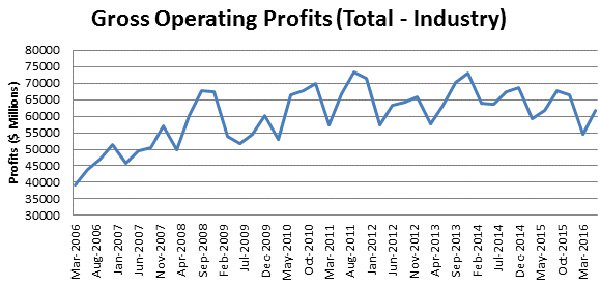
Far more than the 2.0% anticipated, and following a fall of 4.4% in the previous quarter.
Profits in the mining sector rose 14.2 percent on a seasonally adjusted basis, this was despite a fall in volumes, which would indicate a rise in prices received by the mining sector for the quarter.
Profits in the manufacturing sector rose 22.6% on a seasonally adjusted basis, with only a slight increase in volumes. This is a positive sign for Australia’s much-maligned manufacturing sector. This comes as Australian manufacturing PMIs have shown expansion in the sector for each of the thirteen months to July; with the expansion finally coming to a halt in August.
Profits in the constructing sector plunged during the quarter, falling 27.7 percent during the quarter, despite a rise in volumes, which may indicate that the supply of goods and services from the construction sector is starting to become saturated, after a period of strong property price growth.
A seasonally adjusted estimate for wages and salaries rose 0.8 percent during the quarter, with a rise of 2.8 percent for the year to the June quarter. With CPI tracking at an annualised rate of approximately 1 percent, this represents positive real wages growth, which is an encouraging sign for the Australian economy.
The rise in profits for the quarter came after a fall of 4.4 percent in the previous quarter. Despite the strong performance in the 2nd quarter, Australian company profits are exactly where they were a year ago on a seasonally adjusted basis; and they have fallen 4.3 percent on a trend basis.
Although the Q2 profits result was very strong, (and real wages growth in a developed nation is especially positive), there was no yearly growth in gross operating profits. Additionally, manufacturing and services PMIs have started to fall since the end of the quarter; and the strong quarterly profit growth is therefore not solid evidence of a robust economic turn-around in Australia.
General Information Only
This material has been prepared by StocksDigital. StocksDigital is an authorised representative (CAR 000433913) of 62 Consulting Pty Limited (ABN 88 664 809 303) (AFSL 548573).
This material is general advice only and is not an offer for the purchase or sale of any financial product or service. The material is not intended to provide you with personal financial or tax advice and does not take into account your personal objectives, financial situation or needs. Although we believe that the material is correct, no warranty of accuracy, reliability or completeness is given, except for liability under statute which cannot be excluded. Please note that past performance may not be indicative of future performance and that no guarantee of performance, the return of capital or a particular rate of return is given by 62C, StocksDigital, any of their related body corporates or any other person. To the maximum extent possible, 62C, StocksDigital, their related body corporates or any other person do not accept any liability for any statement in this material.
Conflicts of Interest Notice
S3 and its associated entities may hold investments in companies featured in its articles, including through being paid in the securities of the companies we provide commentary on. We disclose the securities held in relation to a particular company that we provide commentary on. Refer to our Disclosure Policy for information on our self-imposed trading blackouts, hold conditions and de-risking (sell conditions) which seek to mitigate against any potential conflicts of interest.
Publication Notice and Disclaimer
The information contained in this article is current as at the publication date. At the time of publishing, the information contained in this article is based on sources which are available in the public domain that we consider to be reliable, and our own analysis of those sources. The views of the author may not reflect the views of the AFSL holder. Any decision by you to purchase securities in the companies featured in this article should be done so after you have sought your own independent professional advice regarding this information and made your own inquiries as to the validity of any information in this article.
Any forward-looking statements contained in this article are not guarantees or predictions of future performance, and involve known and unknown risks, uncertainties and other factors, many of which are beyond our control, and which may cause actual results or performance of companies featured to differ materially from those expressed in the statements contained in this article. S3 cannot and does not give any assurance that the results or performance expressed or implied by any forward-looking statements contained in this article will actually occur and readers are cautioned not to put undue reliance on forward-looking statements.
This article may include references to our past investing performance. Past performance is not a reliable indicator of our future investing performance.