PKP is making THC shots now - looks like they are a hit with consumers
Disclosure: S3 Consortium Pty Ltd (the Company) and Associated Entities own 20,210,000 PKP Shares at the time of publishing this article. The Company has been engaged by PKP to share our commentary on the progress of our Investment in PKP over time. This information is general in nature about a speculative investment and does not constitute personal advice. It does not consider your objectives, financial situation, or needs. Any forward-looking statements are uncertain and not a guaranteed outcome.
THC is the primary psychoactive compound found in cannabis that makes you “high”.
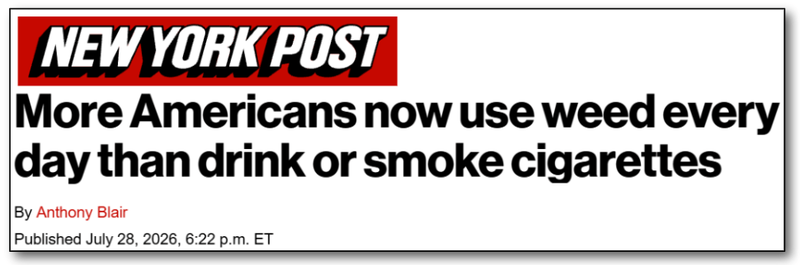
Daily THC use in the USA has now overtaken alcohol.
(source)
It looks like our “THC to replace alcoholic drinks” (or even just put a big dent in market share) thesis for Investing in Peak Processing (ASX:PKP) is gaining more traction.
PKP specialises in the manufacturing, sales, and distribution of THC beverages.
PKP is the #1 THC drink manufacturer in Canada - making ~33% of all THC cans in the country.
Today PKP confirmed it entered the “THC shots” market in recent months - specifically 65 mL single-serve shots containing 10mg of THC.
Sales of THC shots have taken off since the July launch of the product with ~87,456 shots produced in the September 2026 quarter.
PKP’s projection is to grow production to ~1M shots per annum (nearly triple the first quarter production run rate).
Shots retail for C$3.95 to C$4.00 each. PKP has not disclosed gross margins as they are commercially sensitive.
PKP owns and sells technology to "infuse any drink with THC” and then manufacture those drinks at scale.
PKP’s THC-infusion can be applied to ANY drink, so any big alcohol company OR drink maker can use PKP to make a non-alcoholic, THC-infused version of their popular brands.
Think THC-infused teas, seltzers, and mocktails.
We Invested in PKP to see it take its market leadership position in Canada and apply it to the much bigger US market.
And because we think there is a longer term macro trend playing out where people would prefer to drink something else other than alcohol socially.
Mainly to avoid that morning after hangover, reduce calorie and sugar intake, and the health risks of ethanol.
BUT still having something to loosen up with on a Saturday night.
It looks like this trend is really starting to happen now.
According to an article a few weeks ago in PBS News, one of the biggest groups backing THC drinks in the US is... yep... alcohol retailers:

(source)
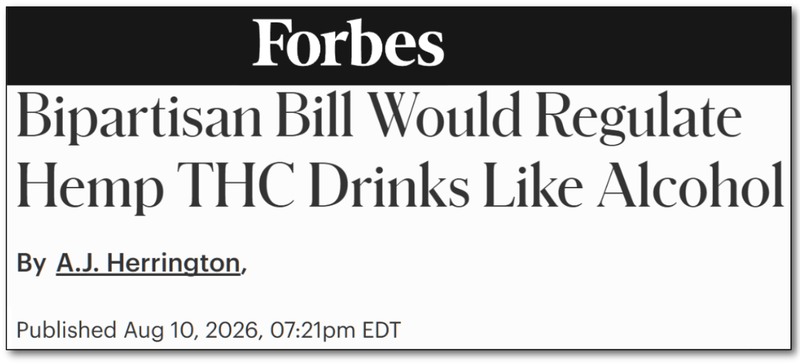
In the government's eyes - regulation is heading the same way the alcohol industry is regulated:
(source)
The single biggest validator for us that the “alcohol to THC drinks” movement could become a much bigger thing is PKP’s working relationship with big alcohol company $2.7BN Boston Beer Company.
Boston Beer Company generated ~US$2BN revenue in the 12 months to September (source) and is best known for: (source)
- Samuel Adams (craft beer)
- Truly Hard Seltzer
- Twisted Tea (alcoholic tea)
- Angry Orchard (hard cider)
- Dogfish Head (craft beer)
- Hard Mountain Dew (in partnership)
The big one for them is “Twisted Tea” which sold 33 million cases in 2024 and is the best selling “hard tea” with more than 80% market share in the USA. (Source)
PKP partners with Boston Beer Co to make a non-alcoholic, THC-infused version of Twisted Tea for sale in Canada (branded as Teapot).
So far, Boston Beer Company hasn't launched a THC drink in the US.
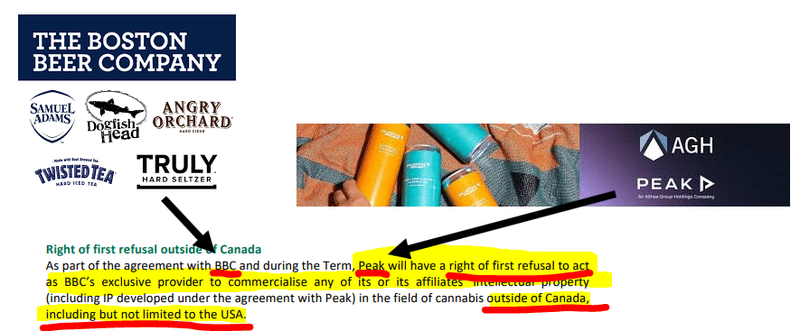
BUT IF Boston Beer Company decided one day that it DID want to launch in the US - PKP’s partnership in Canada gives them a right of first refusal on contract manufacturing for them in the US. (Source)
(Source)
Of course PKP isn’t limited exclusively to Boston Beer Company either.
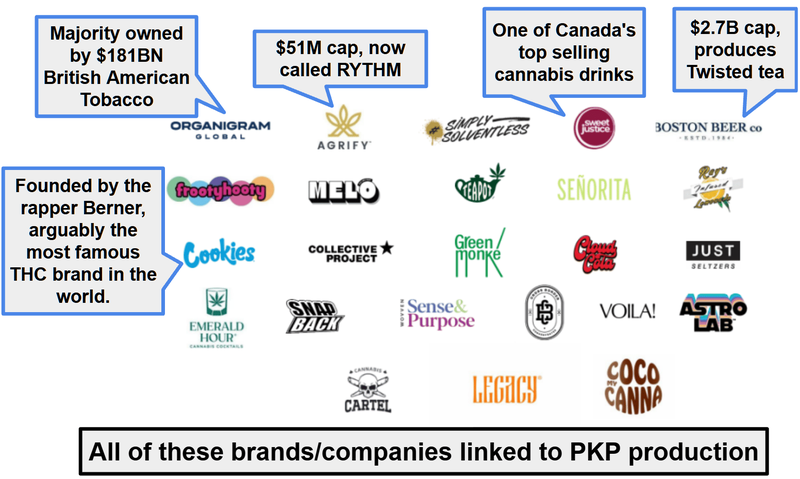
PKP also makes drinks for Organigram - the Canadian cannabis producer ~45% owned by ~$181BN British American Tobacco - plus St. Peter's (Cookies, Green Monké) and Electric Brands (Sweet Justice). (source)
(source)
A big part of PKP’s moat is that its THC-infusion can be applied to ANY drink, so any big alcohol company can use PKP to make a non-alcoholic, THC-infused version of any of their popular brands.
IF Red Bull wants to make a THC infused version of their drink they can also do a deal with PKP.
If Pepsi wants to launch a THC version of their drink, PKP can make it happen.
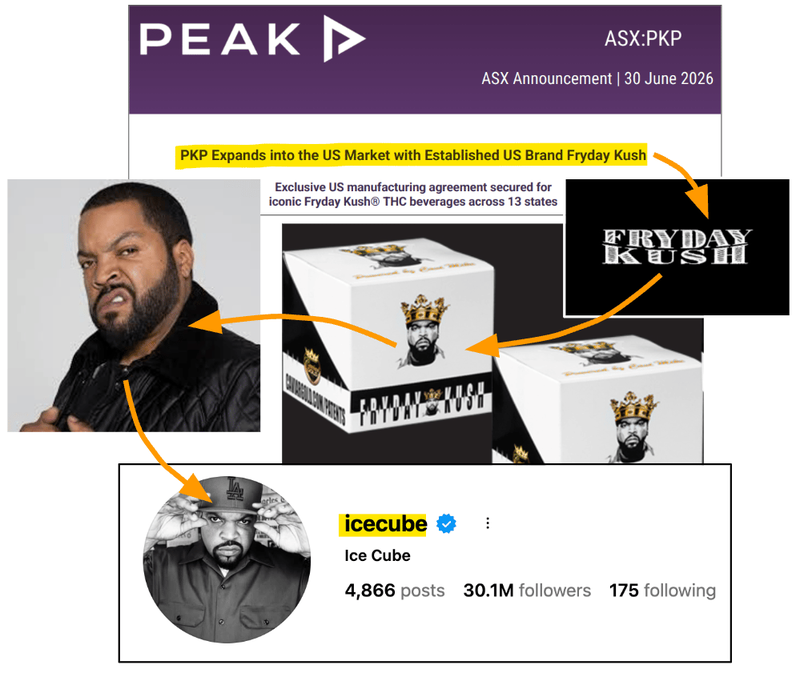
3.5 months ago, PKP signed a deal to manufacture THC drinks for Fryday Kush, a brand created by legendary rapper and actor Ice Cube:
(source)
Yep... Fryday Kush, a brand created by Ice Cube who has over 30M Instagram followers, partnered with PKP to see a THC drink manufactured and brought to market.
When that deal got signed we said we think it could “The bigger impact could come from this deal opening the door to other deals...”. (source)
No better marketing than someone famous for decades, with a massive cultural impact, and 30M followers getting behind your product.
We are waiting for more news on the Fryday Kush partnership from PKP, but for now let’s get back to today’s news.
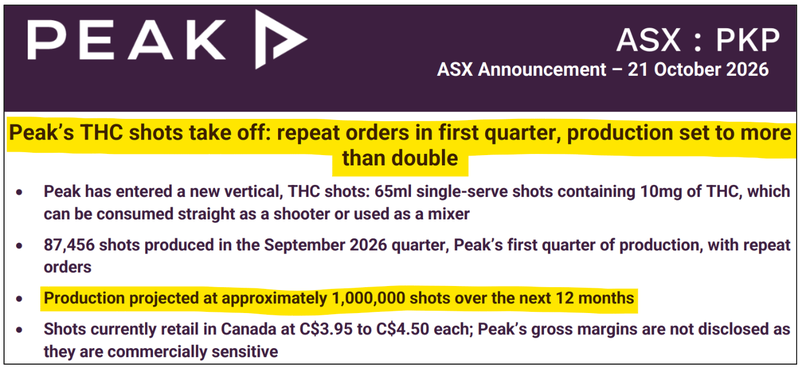
So today PKP announced its launch into a whole new segment - 65ml THC shots:
(source)
A small 10mg serving (the maximum allowed per container under Canadian rules) that can be used as a shot or mixed into a drink.
PKP says it expects production to grow to ~1,000,000 shots over the next 12 months.
The best part is PKP can produce these “in parallel” with PKP’s existing canning lines - so it’s brand new revenue that doesn’t use up any of PKP’s canning capacity.
Nice to see PKP entering a part of the market the majors in the THC space are also entering.
Organigram (45% owned by $181B British American Tobacco) launched a similar product in March:

(source - “Shred” is the brand Organigram has over $200m+ in sales from)
So it's good to see PKP prove its tech can be applied to producing these too.
IF anyone wants to go in and launch their own “shot drink”, again, PKP would be the natural partner.
New deals are very good for a business like PKP’s
A big part of PKP’s business is as a “contract manufacturer.”
PKP is the market leader in Canada - manufacturing ~33% of all cans produced, for ~70% of the brands in the market.
That means a lot of PKP’s costs are fixed - owning and operating a big facility capable of pumping out drinks.
And like most fixed-cost businesses, once the facility is paid for, any additional deals signed make its way to the bottom line (profits) of the business a lot quicker
So new products - like today’s launch into shots - can be very good for PKP.
Especially shots, which run on a dedicated line alongside PKP’s existing canning lines - so it’s extra revenue that doesn’t use up any of PKP’s current can-making capacity.
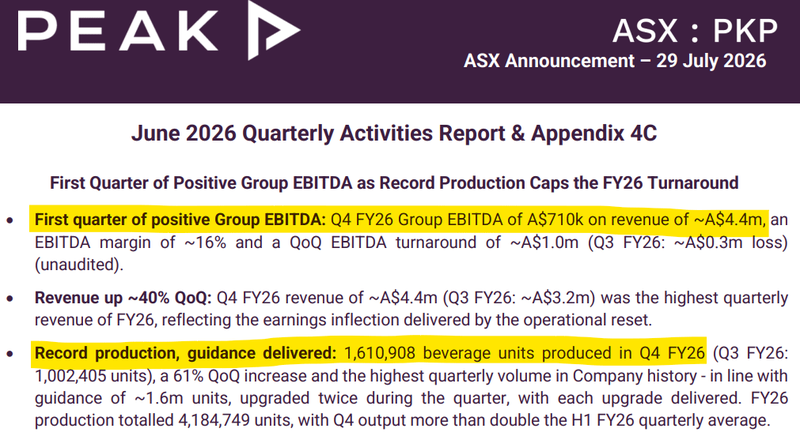
PKP’s last set of results was the June quarterly report where PKP had record quarterly revenue of ~A$4.4M and a record ~1.61M beverage units produced in the quarter.
(source)
The shots business was only launched in July, so we haven’t seen those numbers flow into any of PKP’s financial reports yet.
Hopefully that means financial results are a lot stronger than anyone in the market expects over the next few quarters.
PKP’s September quarter report is due before the end of the month, and will be the first to include the impact of the shots product on the financials.
All of the forward looking indicators are looking relatively strong too.
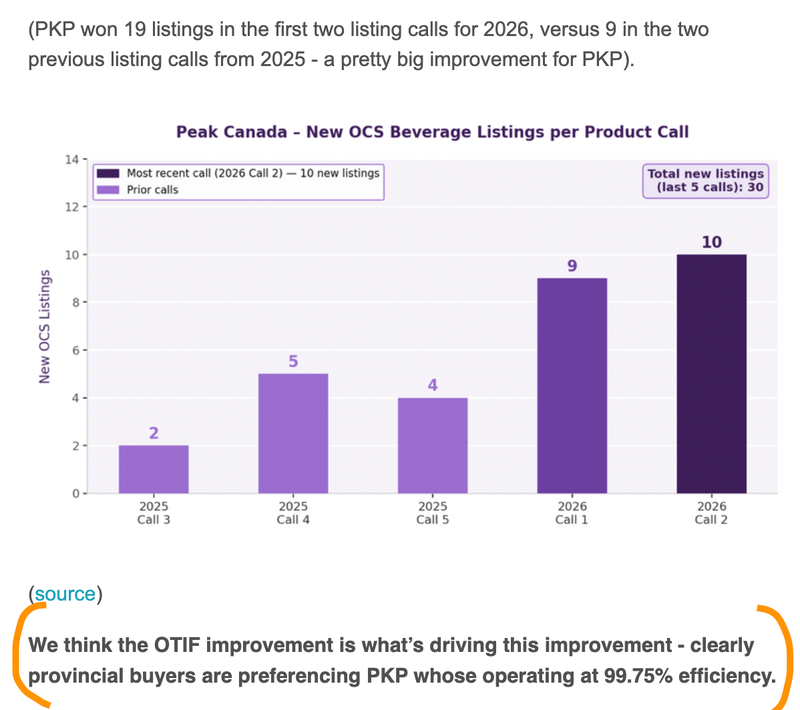
PKP’s “on-time, in-full” delivery score went from 53% (June 2025) to 97% across the June 2026 quarter - through PKP’s biggest-ever production quarter. (source)
(in Canada, THC drinks are bought by centralised provincial distributors - the more reliable you are, the more shelf space you win)
More reliability → more listings → more volume → better financials.
Here is what we said in a note from earlier in the year:
(source)
Now, we are starting to see that reliability translate into financial outcomes for PKP.
We also note PKP was supposed to have ~30+ new product listings launching between June and September 2026 so things could improve further from here. (source)
PKP secured 19 new product listings in the June quarter alone. (source)

(source)
So things are improving at PKP’s core Canadian business...
Market leader in Canada BUT the real “moonshot” for us is PKP cracking the US market
As mentioned earlier, PKP is the market leader in Canada manufacturing ~33% of all cans produced for ~70% of the brands in the market.
We Invested in PKP to see it replicate that market leading model from Canada, into the much bigger US market.
Imagine having 33% market share in a large and mature market like the USA.
So far in the US, PKP has:
- Opened up a manufacturing facility in Florida (September 2024) (source)
- Set up its “EnvisionTM Emulsions technology” facility in Florida (August 2025).
So 2026 has been the first year where PKP was fully equipped to deliver for potential US customers.
In H1 FY26, PKP had already sold 680,000+ cans in the US market - including a deal with one of Florida's most established craft brewers, Funky Buddha.
And after that deal a few months ago, PKP can start manufacturing drinks for Ice Cube’s brand from that same facility.
We are speculating here, but imagine a few Instagram posts from Ice Cube (where he has 30.1M followers) promoting the drink - who knows how many units get sold...
PKP did ~A$3.3M in cash receipts on ~1.6M units produced in the June quarter. (source)
A few million units from Ice Cube’s brand could be material to PKP’s revenue run rate.
(again that's just a big forecast and assumption on our part, we are waiting for more news on this front)
Pretty good in the US so far - but we think the big company making moment comes closer to the end of this year for PKP.
The US THC drinks inflection point could be ~60 days away
For the big US moonshot to materialise for PKP there needs to be mainstream adoption of THC drinks.
Right now we are seeing early signs that adoption is coming:
- Target started with a 10-store pilot in Minnesota (Oct 2025), expanded across Minnesota, and is now rolling THC drinks into 300+ stores across Texas, Florida and Illinois. (source)
- Total Wine & More is reportedly replacing craft-beer sets with cannabis beverages (source).
- Circle K started selling THC drinks in dozens of Dallas–Fort Worth stores in January (source), with plans for up to ~3,000 stores nationwide. (source)
- Sprouts Farmers Market added THC drinks to ~115 stores across Texas and Florida. (source)
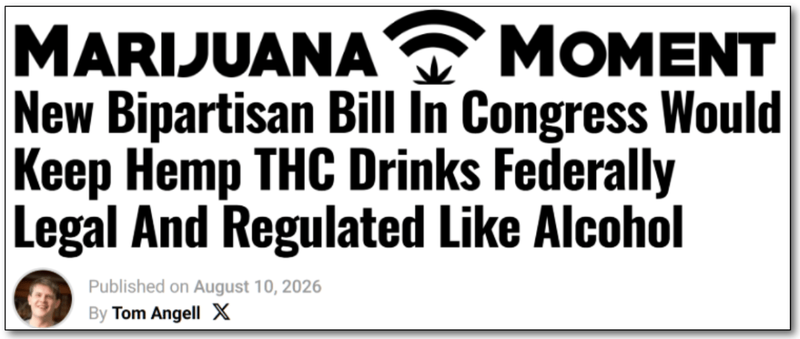
And now (the biggest positive signal for us) the alcohol industry is lobbying FOR THC drinks:
- The Wine & Spirits Wholesalers of America (the alcohol distributors) are backing a bill to keep THC drinks legal and regulate them like alcohol. (source)
- A coalition of America’s biggest alcohol retailers is pushing Congress to regulate low-dose THC drinks through the same “three-tier” system used for beer, wine and spirits. (source)
All of this has happened while there is a looming federal ban on hemp derived THC.
The biggest risk (and opportunity) for PKP in the US is regulation.
In November 2025, a new US federal law redefined “hemp”, imposing a hard cap of 0.4mg of total THC per container for finished products. (source)
(Most THC drinks on the US market today contain 2.5–10mg per serving)
That ban was due to kick in on 12 November 2026.
BUT last month it got pushed back to 11 December 2026. (source)
We think that the delay to 11 December, is a positive sign because it shows a willingness by the government to buy some time to regulate the industry, instead of rushing in an outright ban.
The obvious bear case for PKP is that the ban comes into effect, and the whole industry is halted in the US until regulations are clearer.
BUT IF instead of that, we get clear regulatory guidelines for the industry we think it will be very good for PKP.
Because PKP knows exactly how to operate in a highly regulated industry - like Canada where it's a market leader.
We are PKP shareholders and are very biased here...
But it feels like the US government wants to regulate (instead of an outright ban).
Look at what’s been proposed in government over the last few months:
- 24 June 2026: The White House budget office formally asked Congress to either replace the ban with a regulated framework, or delay it. (source)
- 22 July 2026: A bipartisan bill (the Lawful Hemp Protection Act) was introduced to replace the ban with a full regulatory framework: 21+ sales, testing and labelling rules, and a three-tier system for hemp drinks. (source)
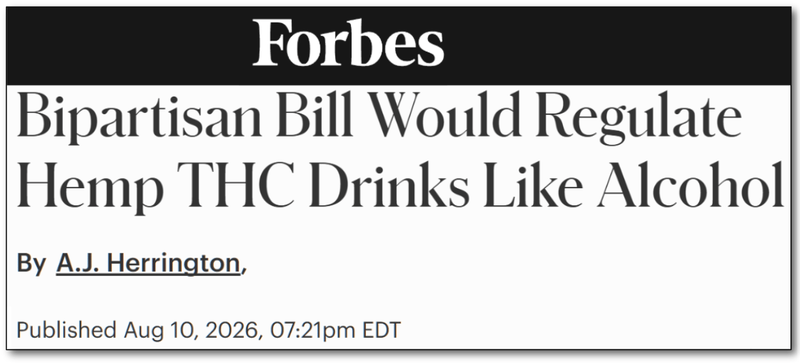
- 10 August 2026: A second bipartisan bill (the Beverage Regulatory Parity Act) was introduced specifically to keep THC drinks legal and regulate them like alcohol: 21+ and sold through the same three-tier system as beer, wine and spirits. (source)
(source)
That 10 August bill is the most relevant to PKP.
IF something like that were put into law then THC drinks would be treated like alcohol, with licensed manufacturers, testing, labelling and age limits.
Very very similar to the rules in Canada (which PKP has navigated successfully).
If we had to make a prediction - to us it feels like the regulation will be a mirror of everything that's applicable for alcohol in the US (plus some edge case regulation for THC).
BUT of course there is still a very real risk the ban goes through on 11 December, which would materially impact PKP’s US business.
We think a regulated US market will be great for PKP
PKP already operates in the most tightly regulated THC-drinks market in the world - Canada.
And it’s become the #1 manufacturer in that market (~33% of all cans).
Regulation creates barriers - compliant manufacturing, testing, labelling, licensing etc - all of which is hard to replicate especially in a new sector like THC drinks.
And more importantly, it's even harder to convince a big drink brand to trust you with the launch of their new product, if you haven’t done this at scale before.
We think that if/when the US lands on a regulated framework, the serious brands will need a manufacturing partner they can trust (like PKP).
In business this is called “regulatory capture” (or barrier to entry ) - when bigger, compliant incumbent companies welcome (even encourage) regulation because it solidifies their position in the market by making it harder for smaller, non-compliant operators.
We think that another positive to come from regulation will be a more certain and predictable environment for the bigger brands to start launching drinks.
The more the industry grows in general, the better it will be for PKP.
Of course we could be wrong here - and obviously as shareholders in PKP we are biased.
Ultimately, success in the US will be what leads PKP to delivering our Big Bet for the company which is as follows:
Our PKP Big Bet
“PKP re-rates to a $200M+ market cap on the back of strong THC Beverage sales growth in North America”
NOTE: our “Big Bet” is what we HOPE the ultimate success scenario looks like for this particular Investment over the long term (3+ years). There is no guarantee that our Big Bet will ever come true. There is a lot of work to be done, many risks involved, including financing risk, regulatory risk, and market adoption risk - just some of which we list in our PKP Investment Memo.
Success will require a significant amount of luck and good management. Past performance is not an indicator of future performance.
What we want to see next from PKP
There are three things we're watching over the next 6–12 months.
🔄 Operational updates in Canada.
PKP did ~A$3.3M in cash receipts on ~1.6M units produced in the June quarter. (source)
We want to see PKP improve on those metrics over the coming quarters:
- 🔄 Q1-FY27 numbers.
- 🔄 Improve capacity utilisation.
- ✅ Launched new product line - THC shots
- 🔲 More new brand partnerships in Canada
🔄 More manufacturing deals signed in the US
We want to see more deals signed in the US:
- ✅ Fryday Kush (Ice Cube) - first US brand-partner deal signed
- 🔲 More US manufacturing deals
🔄 US regulatory resolution
And of course the big one - the 11 December 2026 regulatory deadline. (source)
We are hoping to see the US land on a regulated framework (or a delay) rather than a hard ban on the THC drinks industry.
What could go wrong?
The two key risks for PKP right now are regulatory risk and financing risk.
As mentioned multiple times in today’s note the single biggest risk in the medium term is the US federal ban on hemp-derived THC loopholes that could make most current US THC drinks non-compliant.
IF that ban is put in place then PKP’s US business is effectively halted and we think it could re-rate PKP’s share price lower.
Regulatory Risk
Canada: The THC beverage market is tightly regulated. Any change in Canada’s regulatory environment could disrupt PKP’s ability to produce, sell, or distribute products.
United States: The market operates in a legal grey area under the 2018 Farm Bill, which permits hemp-derived THC.
However:
- Several states are cracking down (e.g., Texas is attempting bans).
- Regulatory uncertainty may limit national expansion, with state-by-state laws varying.
- A potential federal reclassification of cannabinoids could change market dynamics overnight.
Source: “What could go wrong” - PKP Investment Memo - 11 July 2025
The second risk is financing risk.
PKP is reporting positive EBITDA months, but this does not guarantee cashflow is positive.
There is always a chance PKP needs to raise more capital in the future.
Financing Risk
PKP is still in early commercialisation in the US and may need additional capital to expand into new states or marketing spend to build its brands. In the absence of profitability, PKP may dilute shareholders through capital raises or struggle to fund growth internally.
Source: “What could go wrong” - PKP Investment Memo - 11 July 2025
Other risks
Like any small-cap cannabis technology and manufacturing company, PKP carries significant risk, here we aim to identify a few more risks.
The company's US growth strategy heavily relies on the commercial success of third-party brands like Ice Cube's Fryday Kush. There is always a chance celebrity-backed products fail to gain traction AND major partners like Boston Beer Company choose not to exercise their right of first refusal in the US.
Any unforeseen operational disruptions, equipment failures, or supply chain bottlenecks could impact the company's financial turnaround negatively.
While the US THC beverage sector is currently expanding, it remains a young and highly competitive market segment. There is no guarantee the market grows large enough for PKP to build a viable business in the US.
Investors should consider these risks carefully and seek professional advice tailored to their personal circumstances before investing.
Our PKP Investment Memo
Our Investment Memo provides a short, high-level summary of our reasons for Investing. We use this memo to track the progress of all our Investments over time.
In our PKP Investment Memo, you can find the following:
- What does PKP do?
- The macro theme for PKP
- Our PKP Big Bet
- What we want to see PKP achieve
- Why we are Invested in PKP
- The key risks to our Investment Thesis
- Our Investment Plan
General Information Only
This material has been prepared by StocksDigital. StocksDigital is an authorised representative (CAR 000433913) of 62 Consulting Pty Limited (ABN 88 664 809 303) (AFSL 548573).
This material is general advice only and is not an offer for the purchase or sale of any financial product or service. The material is not intended to provide you with personal financial or tax advice and does not take into account your personal objectives, financial situation or needs. Although we believe that the material is correct, no warranty of accuracy, reliability or completeness is given, except for liability under statute which cannot be excluded. Please note that past performance may not be indicative of future performance and that no guarantee of performance, the return of capital or a particular rate of return is given by 62C, StocksDigital, any of their related body corporates or any other person. To the maximum extent possible, 62C, StocksDigital, their related body corporates or any other person do not accept any liability for any statement in this material.
Conflicts of Interest Notice
S3 and its associated entities may hold investments in companies featured in its articles, including through being paid in the securities of the companies we provide commentary on. We disclose the securities held in relation to a particular company that we provide commentary on. Refer to our Disclosure Policy for information on our self-imposed trading blackouts, hold conditions and de-risking (sell conditions) which seek to mitigate against any potential conflicts of interest.
Publication Notice and Disclaimer
The information contained in this article is current as at the publication date. At the time of publishing, the information contained in this article is based on sources which are available in the public domain that we consider to be reliable, and our own analysis of those sources. The views of the author may not reflect the views of the AFSL holder. Any decision by you to purchase securities in the companies featured in this article should be done so after you have sought your own independent professional advice regarding this information and made your own inquiries as to the validity of any information in this article.
Any forward-looking statements contained in this article are not guarantees or predictions of future performance, and involve known and unknown risks, uncertainties and other factors, many of which are beyond our control, and which may cause actual results or performance of companies featured to differ materially from those expressed in the statements contained in this article. S3 cannot and does not give any assurance that the results or performance expressed or implied by any forward-looking statements contained in this article will actually occur and readers are cautioned not to put undue reliance on forward-looking statements.
This article may include references to our past investing performance. Past performance is not a reliable indicator of our future investing performance.