WCE kicks off geophysical surveys on across silver project in WA
Our silver Investment West Coast Silver (ASX: WCE) just started geophysical surveys across its 70% owned Elizabeth Hill project in the Pilbara - one of the highest grade silver mines to ever operate in Australia.
The old mine produced 1.2M ounces of silver at ~2,194g/t before shutting in 2000, not because the silver ran out, but because the price had collapsed to ~US$5/oz.
In April this year WCE defined a maiden JORC 2.8M ounce silver resource (with an average grade of 617/g/t silver).
WCE is developing the project with a nearer term restart plan, helped because this part of the project sits on an existing mining licence, which historically produced.
But one of the other reasons we Invested was the potential to find more silver resources across the wider project area, the potential for new Elizabeth Hill’s.
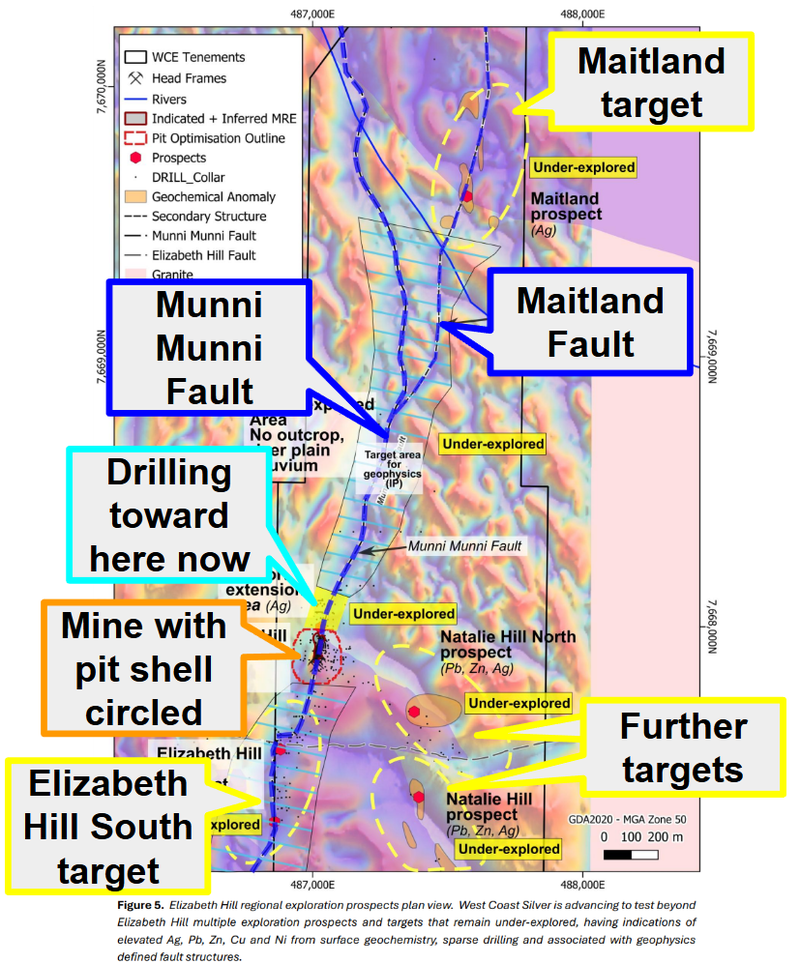
The known resource sits on the known Munni Munni fault, which runs north to south, with other smaller faults branching off of it, most notably and largest of these is the Maitland Fault to the north.
Here is a summary image with the current drilling near/at the mine, the fault extending north and south plus some of the targets that WCE is eying off:
(source)
Searching for more silver along the fault
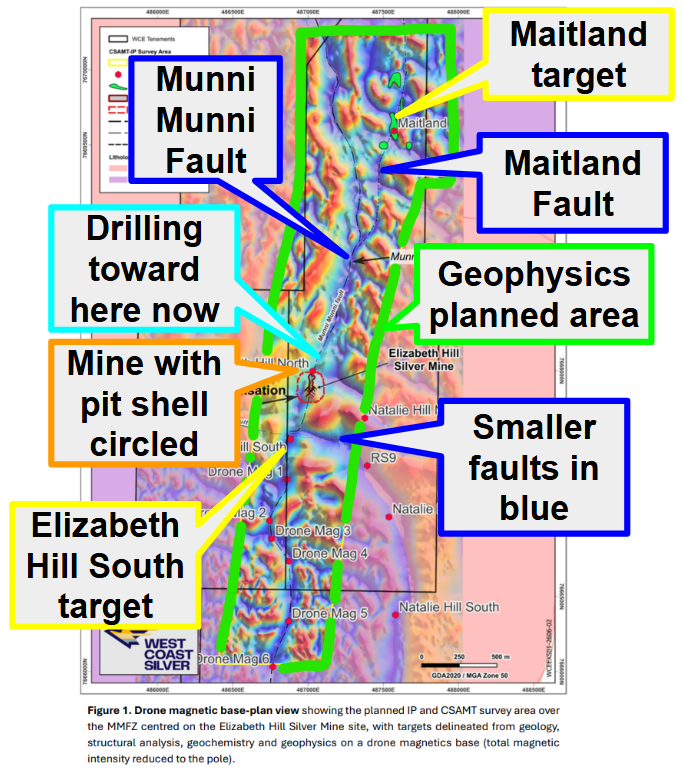
WCE will be running the survey roughly 2km north and south of the mine - around 4km of the Munni Munni fault - covering several prospects, including Maitland to the north and Elizabeth Hill South to the south.
(source)
It uses two complementary methods run together, Induced Polarisation (IP) and CSAMT, which let WCE test the fault to greater depth than has been explored before.
IP measures the "chargeability" of the earth (certain minerals hold a charge better than others) and CSAMT (Controlled-Source Audio-Magnetotellurics) is a frequency-domain electromagnetic (EM) sounding technique, used to get high-resolution maps of sub-surface electrical resistivity.
WCE also applied for and received a $114,312 WA Government co-funding grant that covers 50% of the cost, so it’s good to see WCE has been searching avenues to make cash stretch further.
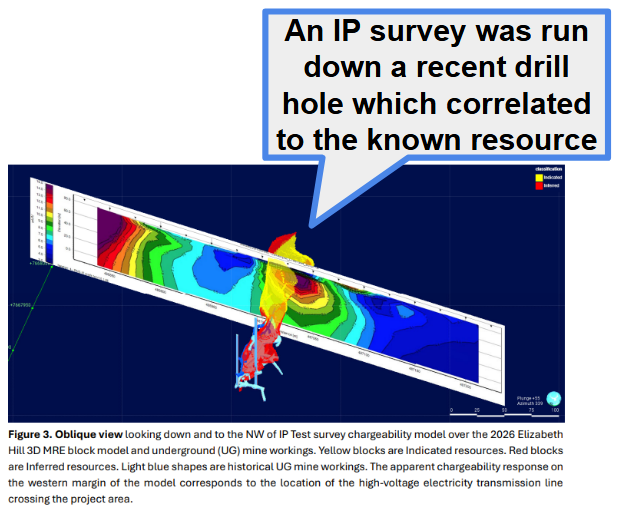
This follows an earlier IP test survey run over the existing Elizabeth Hill mine, where the chargeability response lined up with the known mineralised zone.
So WCE has been able to confirm the method works there, which gives it confidence the same technique can pick up Elizabeth Hill style mineralisation if it exists elsewhere along the fault.
(source)
There are no guarantees of course, but if the surveys do flag anything, those anomalies would be worth following up with more detailed exploration eg sampling then drilling if positive results.
Drilling and studies continue to progress at the mine
Meanwhile, diamond drilling is still going at the mine where it’s testing extensions below the resource and infilling it to firm up the Maiden Resource Estimate released in April.
So we have assays from WCE's most recent round of drilling also still to come.
And on the development side, economic studies of the near-surface mineralisation are progressing toward a Scoping Study, which WCE expects to get underway in Q4.
Some early mine planning has already been done here too - the maiden resource was built around an optimised open pit.
WCElaid out a growth and development plan for a starter pit back in May which we covered.
What we want to see next from WCE
Recently, WCE released an updated presentation here.
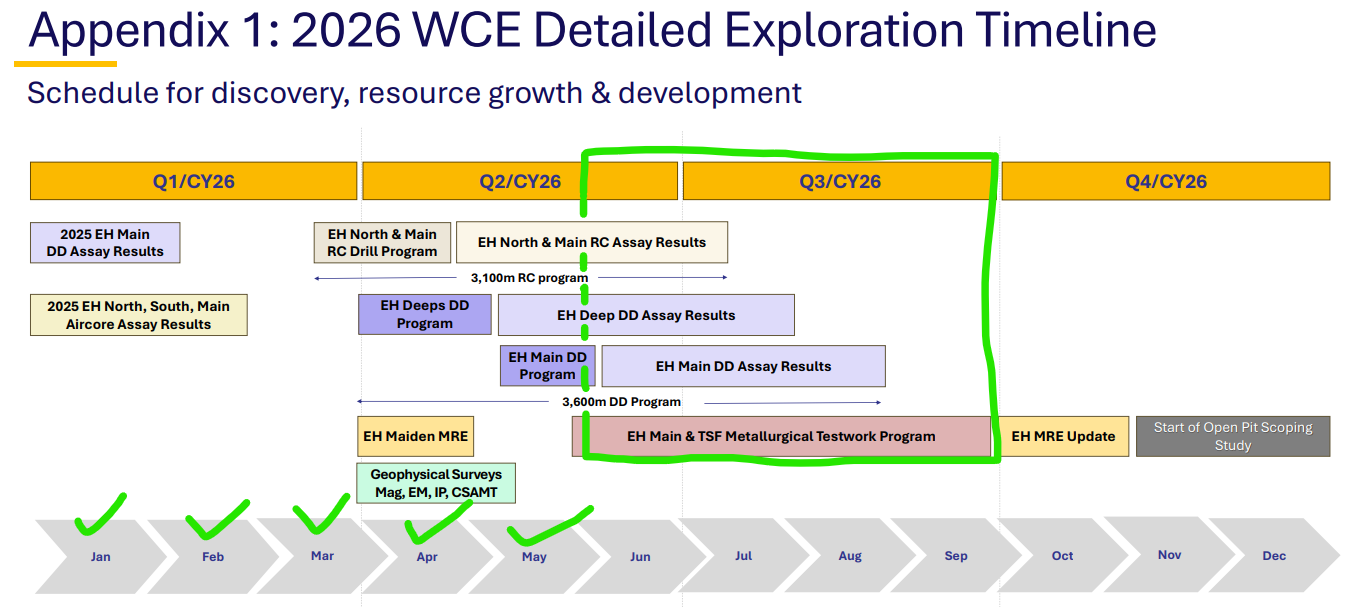
It’s always good to see a Gantt chart showing what’s ahead in these presentations - a one pager on what to expect next.
(source)
The three things we are most looking out for are:
- The RC drill campaign on the targets to the north of the Elizabeth Hill Mine (assays are due).
- The diamond drilling going for at depth extensions to the Elizabeth Hill mine (also underway).
- Geophysics across the broader project area (today’s update)
And then all of that data rolling into what we expect to be an updated JORC resource before the Scoping Study before the end of the year, expected to get underway in Q4.